Token Standards
In the Blockchain ecosystem, any digitally transferable asset between two people is called a token. Tokens can be native to a blockchain, e.g. BTC is the native token of Bitcoin or tokens can also be created and hosted on an existing blockchain via a smart contract. Some tokens, called stablecoins, follow the price of fiat currencies (e.g. USD, EUR). Others, called NFT, can represent collectibles or art pieces. Finally, tokens can represent rights of ownership of real-world estates or companies (i.e. stock tokens[1]).
In this chapter, we will see the main types of tokens and the token standards on Mavryk.
Token standard
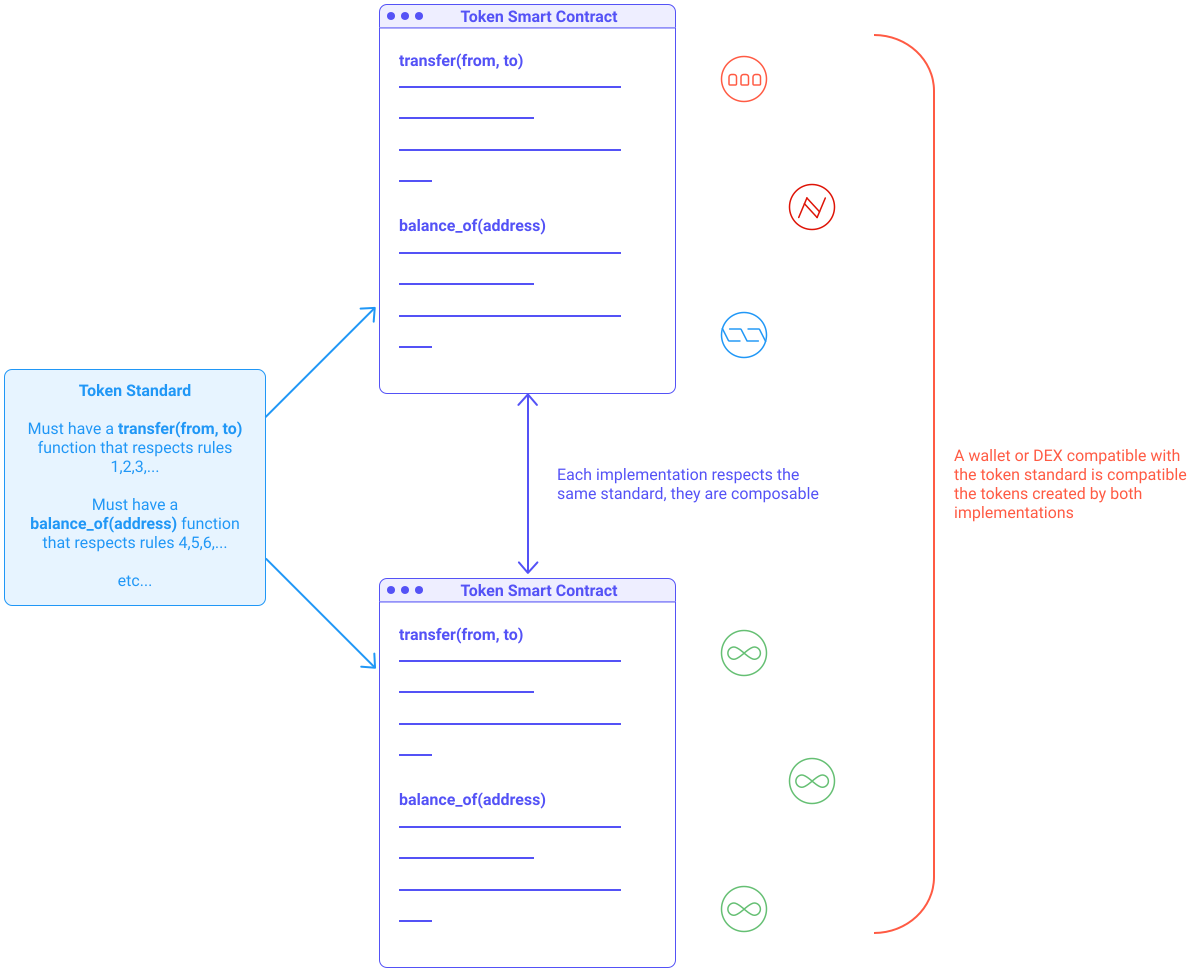
A token standard is an interface, and a set of rules, that a smart contract must respect to be compatible with the common standards. Typically, token standards define how tokens can be transferred and how to keep a consistent record of those transfers.
Multiple implementations of a standard can co-exist, but they must all respect the interface and rules of the standard. Standards ensure that smart contracts remain compatible, so for instance, when a new project issues a token, it remains compatible with the existing decentralized exchanges, wallets, etc.
Fungible & Non-Fungible Tokens
The most basic token is the Fungible Token, i.e. a class of identical, interchangeable tokens. For instance, two MVRK tokens are identical and interchangeable, just like a US dollar is identical and interchangeable with another US dollar. Both are exactly the same as the other.
However, a token can represent much more than a fungible asset. For instance, a concert ticket in the front row is obviously not equivalent to a concert ticket in the last row. These tickets are part of the same class (i.e. concert tickets), but they are not interchangeable: they are non-fungible. Two pieces of art are also non-fungible. The ownership of these assets can be coded with a Non-Fungible Token (or NFT for short) and then bought, sold, exchanged, etc., just like any other token. NFTs are particularly interesting as collectibles as their scarcity can be demonstrated and proven by the blockchain (i.e. an owner can prove that he has the only copy in the whole world).
Token standards on Mavryk
MRC-10 RWA Token Standard
The MRC-10 RWA Token Standard is Mavryk's framework for fungible tokens, similar to Ethereum's ERC-20. It facilitates the creation and management of interchangeable assets by providing essential features such as balance tracking, transfer operations, and an approval mechanism for third-party spending. By adhering to MRC-10, developers can ensure that their tokens are compatible with the broader Mavryk ecosystem, enhancing interoperability and ease of use for wallets and dApps. This standard serves as a vital building block for fostering a dynamic and cohesive token economy on the Mavryk network.
Key Features:
- Fungible token support
- Balance tracking
- Transfer operations
- Approval mechanism for third-party spending
MRC-20 RWA Token Standard
The MRC-20 RWA Token Standard is Mavryk's unified token standard. It aims to provide significant expressivity to contract developers, allowing them to create new types of tokens while maintaining a common interface standard for wallet integrators and external developers. A variety of transfer permission policies can also be defined, such as how most tokens can be transferred, who can perform a transfer, and who can receive tokens. A token contract can be designed to support a single token type or multiple token types to optimize batch transfers and atomic swaps.
It's comparable to both ERC-20 and ERC-721 on Ethereum. It supports a wide range of token types:
Key Features:
- fungible (equivalent to ERC-20 on Ethereum),
- non-fungible (equivalent to ERC-721 on Ethereum),
- non-transferable (equivalent to ERC-1238 on Ethereum),
- as well as multi-asset contracts (equivalent to ERC-1155 on Ethereum).
NOTE: Both MRC-10 and MRC-20 standards incorporate advanced features for regulatory compliance and transparent asset management, as outlined in the MRC-30 RWA Token Standard.
MRC-30 RWA Token Standard
The MRC-30 RWA Token Standard is Mavryk's pioneering solution for tokenizing real-world assets. It addresses the growing need to digitize real-world assets for integration with decentralized finance while ensuring regulatory compliance.
Key features of the MRC-30 RWA Token Standard include:
Versatile Asset Tokenization:
- Supports tokenization of various real-world assets, including:
- Real estate
- Commodities
- Other tangible assets
- Supports tokenization of various real-world assets, including:
Regulatory Compliance:
- Incorporates advanced compliance measures, including:
- KYC integration directly into the token contract
- Ensuring adherence to regulatory requirements across different jurisdictions
- Incorporates advanced compliance measures, including:
Transparent Asset Management:
- Provides:
- On-chain balance tracking
- Full transparency features for efficient auditing and verification of token movements
- Provides:
Scalability:
- Designed to handle:
- Wide range of assets
- Various transaction volumes
- Suitable for businesses of all sizes and industries
- Designed to handle:
Advanced KYC Integration:
- Utilizes contextual transfer validation, assessing multiple factors pre-transfer, including:
- Country-specific rules
- Region-specific rules
- Investor types
- Utilizes contextual transfer validation, assessing multiple factors pre-transfer, including:
On-Chain Balance Tracking:
- Maintains detailed, on-chain records of all transfers and user balances
- Automatic snapshots taken whenever there's a change in a user's balance
The MRC-30 RWA Token enables various capabilities, including:
- Secondary trading of real-world assets
- Automated, instant lending using RWA tokens as collateral
- Accounting automation
- Creation of smart ETFs
- Programmable dividend distributions
- Improved transparency and efficient auditing
MRC-40 mToken Standard
The MRC-40 mToken Standard is specifically designed for Liquidity Provider (LP) tokens used in Maven Finance. These tokens represent a user's deposit in a DEX or lending pool.
Key Features:
- Represents liquidity provided to DEXes or lending pools
- Acts as a "receipt" for deposits
- Transferable, allowing users to trade their liquidity positions
- Redeemable for the underlying assets plus any accrued rewards
Use Cases:
- DEX liquidity provision
- Lending pool participation
- Yield farming
Regulations
If you plan to create a token, make sure to check the regulations in your country. There are rules to respect depending on the type of token you are creating, its representation, and the taxes to be paid. In the EU, the MiCA law is already in effect.
Risks
Always be cautious as anyone can create tokens on Mavryk. Before purchasing a token, make sure to question its value. Is the smart contract of the token open-source? Has it been audited? Is there a hard cap? Indeed, any rule regarding creating tokens or their transfer can be coded into the smart contract. For instance, uncapped tokens could be infinitely minted by their author, rendering their value null.
Keep in mind that holding a token in your wallet doesn't, in itself, guarantee that your token is safe.
Indeed, holding a token means that the token's smart contract holds a record that associates your public address with a balance. But if the smart contract is malicious or has bugs, that record could be altered, erased, or frozen, making your tokens unusable even if they are in your wallet.